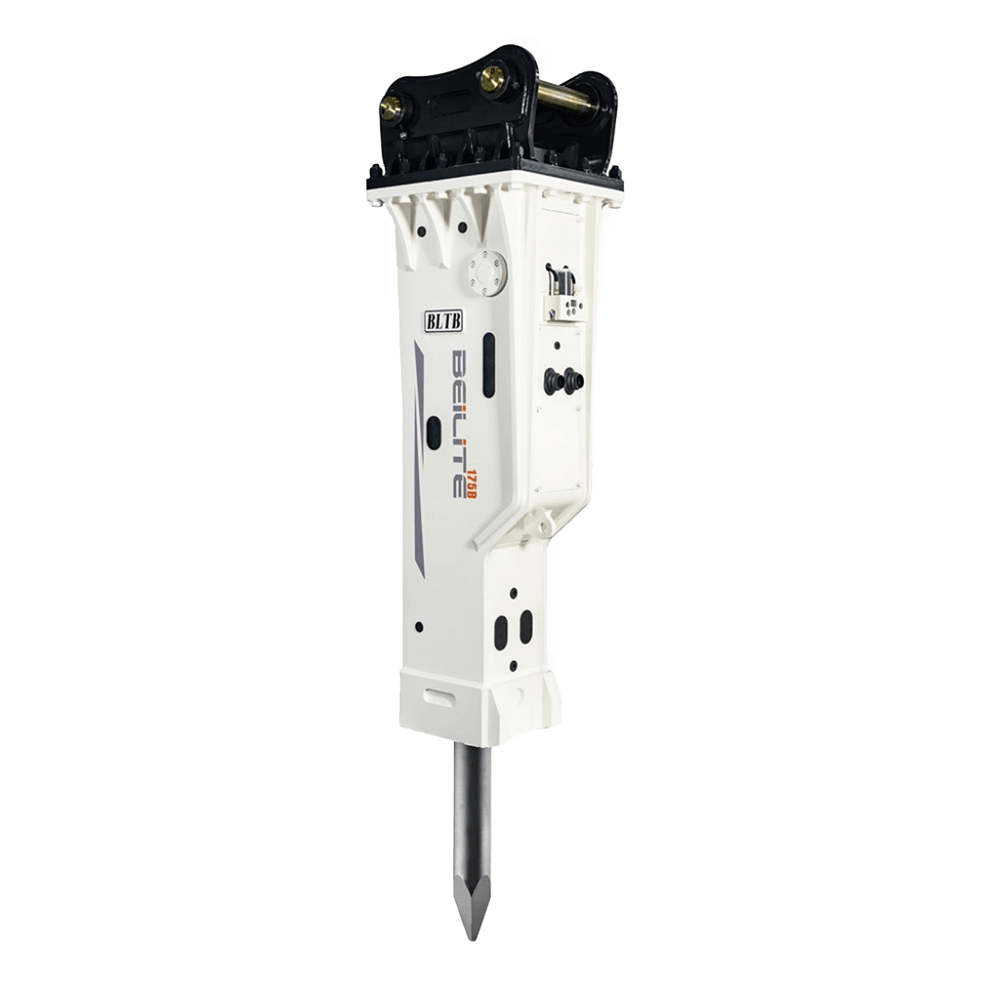
BEILITE has been manufacturing and developing hydraulic breakers for over 20 years, and many people are unsure where to start.
Despite their rugged appearance, hydraulic breakers are precision-engineered tools that must be selected carefully and operated correctly. Choosing the wrong model can lead to costly problems. An oversized breaker may place excessive stress on the carrier, resulting in structural damage, premature wear, and unnecessary fuel consumption. On the other hand, choosing a breaker that is too small often leads to constant overloading, overheating, and premature failure of critical components.
Selecting the right hydraulic breaker is not just about matching size or cost; it’s about ensuring performance, reliability, and long-term value. Next, BEILITE will explore the key factors to consider so you can choose the breaker that best suits your equipment, working conditions, and business goals.
Circuit breaker types and installation methods
Hydraulic breakers come in a variety of configurations, and the correct choice depends on your application, job site conditions, and carrier type.
It is also important to note that skid-steer loader breakers and excavator breakers are not interchangeable. They differ in mounting systems, hydraulic connections, operating weights, and structural designs. Be sure to verify that the breaker is specifically designed for your vehicle type and meets its rated specifications. Even temporary use of the wrong type of attachment can result in equipment damage and safety hazards.
1. The most common type of breakers for excavators are the ones that are put on top and have hydraulic cylinders above the impact mechanism.Well-suited for a wide range of applications.
2. Side-mounted type has an open-frame design, with hydraulic connections on the side of the housing. This is a great choice for construction, demolition, and quarrying operations because it is versatile and affordable. Its open design also facilitates maintenance and repairs.
3. Enclosed (silent) breakers are fully encased in a housing that effectively reduces noise and vibration and prevents debris from flying during operation. They are often the only option for demolition work in cities, or for work near hospitals or schools.
Factors to consider when purchasing hydraulic breakers
Choosing the right hydraulic breaker isn’t as simple as picking a model from a product catalog. Many buyers make the mistake of only looking at the breaker itself. They check the technical details, compare prices, and then order it.
They don’t think about the frame that the equipment will be mounted on. This approach often leads to equipment mismatches, poor performance, and unnecessary costs. You need a plan that is done bit by bit. This plan must think about your machines, where you use them, and what you will need them to do in the future.
Let’s take a closer look at each step.
Start with the carrier, not the circuit breaker
When selecting a hydraulic breaker, the most important factor is the machine on which it will be mounted. This is precisely where most buyers go wrong—they choose the breaker first and only then consider compatibility with the host machine. They don’t even bother to check.
Taking the time to verify these carrier specifications before selecting a breaker can prevent the vast majority of compatibility issues and protect both your attachment and your machine.
- Machine model and operating weight: Whether you’re using an excavator, backhoe loader, or skid-steer loader, the machine’s operating weight is the starting point for selecting a breaker. Generally, the breaker’s operating weight should be approximately one-tenth of the machine’s operating weight.
- Hydraulic system specifications: Confirm your machine’s hydraulic output, particularly the flow rate (liters per minute) and operating pressure (bar or pounds per square inch). Each breaker has a specific flow rate and pressure range required for proper operation. Exceeding or falling short of these ranges will compromise performance.
- Auxiliary Hydraulic Circuit (Breaker Circuit): This is the most commonly overlooked factor. Not every excavator or loader can power a breaker.
Identify the type of work
Once you have a clear understanding of the carrier’s capabilities, the next step is to identify the specific tasks you need the breaker to perform. Each application places different demands on the breaker.
Do you crush reinforced concrete, soft rock, granite, or compacted asphalt? For hard rock, heavy impacts are more effective than rapid ones, as high impact force is necessary to break up dense materials. For concrete and asphalt, a higher impact frequency is generally more effective, as a faster rate of impact can break up the material more efficiently without the need to apply maximum force with each strike.
Daily operating time is also critical. Will the breaker be used lightly for two to three hours a day, or will it operate continuously under heavy duty for eight hours or more? Heavy-duty, high-cycle applications require a durable and heat-resistant breaker.
Please consider any construction site restrictions that may apply. Are you working in an urban area with noise control regulations? Are you near a hospital or residential area? Are there vibration limits? Is there a possibility of underwater operations? These restrictions may immediately rule out certain types of breakers and lead you to seek specialized solutions.
Circuit breaker types and installation methods
Excavators: Top mount is typically chosen. This mounting method is closer to the excavator’s original boom structure, provides a more stable center of gravity, and offers the operator a better downward field of view.
Skid-steer loaders/loaders: Side mounting is typically preferred. Because the machine’s linkage structure limits overhead clearance, side mounting allows the breaker to swing more effectively within the machine’s radius.
Backhoe loaders require specific mounting brackets to connect their rear-mounted attachments.
Power Transmission Mechanisms
Fully Hydraulic: Simple in structure and relatively easy to maintain, this system relies entirely on a hydraulic system for drive.
Gas-Assisted (Nitrogen): High-pressure nitrogen is charged into the cylinder to serve as an energy storage medium. This design generates greater impact force and reduces the impact on the host machine’s hydraulic system (with lower reaction forces); it is currently the mainstream design for heavy-duty breakers.
Do you need a quiet model?
Silent hydraulic breaker with an enclosed housing not only reduces noise levels by up to 50% but also effectively minimizes dust dispersion. For construction projects in urban areas, near residential neighborhoods, or in tunnels, this is an essential choice for complying with environmental regulations and protecting operators’ hearing.
Evaluate advanced features
BEILITE hydraulic breakers also offer a range of advanced features that can significantly improve performance, reduce operating costs, and extend service life. Some are standard, while others are optional; please pay close attention to the following points:
ABF (Anti-Blank Firing) System
An empty strike causes a destructive shock wave to travel backward along the hammer head and its internal components. The automatic shutdown system detects this situation and immediately stops operation.
Automatic Lubrication System
It automatically delivers grease to key wear points during operation. This not only reduces the need for routine maintenance but also helps maintain optimal performance over the long term.
Energy Recovery System
It captures and reuses the energy generated after each impact, rather than allowing it to be lost as heat. The recovered energy is fed into the next impact cycle, improving efficiency and reducing fuel consumption.
Variable Frequency/Dual-Mode Settings
Allows switching between high-frequency and low-energy modes without changing attachments, enabling work on different types of materials.
Having more features does not necessarily mean better quality; it also entails higher costs and increased maintenance complexity. Please assess whether these features are necessary given your specific operating conditions and daily workload.
Consider brand, build quality, and total cost of ownership
Most buyers tend not to realize the importance of this until they actually need it. A responsive, knowledgeable suppliers can resolve issues quickly, ensuring your business runs smoothly.
- Warranty terms and actual coverage: Understand the specifics of what is and isn’t covered, as well as the duration of the warranty.
- Parts availability in your region: If your breaker is idle while waiting for a seal kit, a well-known brand with no local parts inventory is essentially no different from an unknown brand.
Total cost of ownership
Ultimately, you should consider the total cost rather than just the purchase price.Do not merely compare purchase prices; rather, estimate the total operating cost of each hydraulic breaker throughout its service life. This includes the purchase price, estimated maintenance and spare parts costs, variations in fuel consumption, anticipated downtime, and the resale or replacement value.
A hydraulic breaker that costs 20% more initially but offers twice the service life and lower maintenance costs than another model is almost always the wiser investment.